


Differential Pressure Control (DPC)
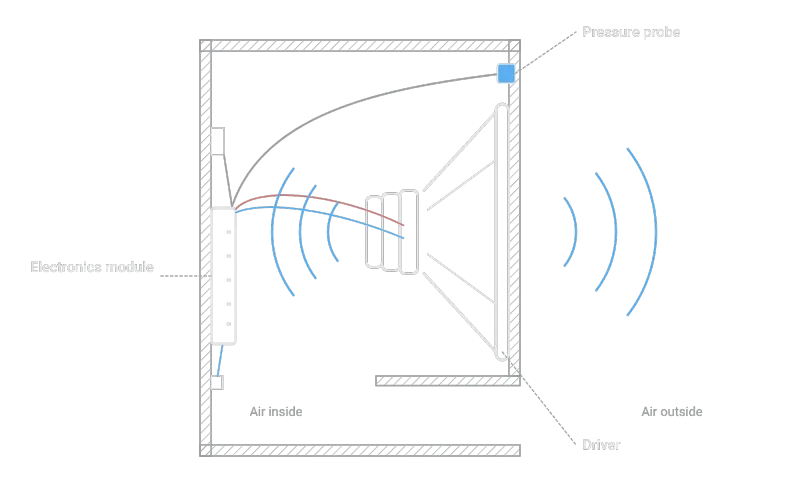
Differential Pressure Control (DPC) pairs a pressure probe with the DSP: the probe measures the difference in sound pressure between the inside and the outside of the loudspeaker, and the DSP can adapt the transducer’s behavior in real time.
How does Differential Pressure Control work?
- Sense - a first-order pressure probe, mounted in the cabinet wall, senses the difference in sound pressure between the two volumes of air inside and outside the loudspeaker.
- React - the DSP can react in real time and adaptively modify the transducer’s behavior. These advanced functionalities are possible only with a 0 latency DSP (10 µs).
Key facts
- Sensor: a pressure probe in the cabinet wall.
- Processing: a 0 latency DSP (10 µs).
- Benefit: Higher SPL for the same THD compared to a traditional system. Compensation for transducer aging, keeping acoustic performance unchanged over time.
What are the advantages of Differential Pressure Control ?
- Control of the acoustical pressure field
- Complete control over sonic performances
- Higher SPL for the same THD of a traditional system
- Consistency in system performances with time and use
More Technologies
DSP TechnologyHow does Powersoft’s onboard DSP work? · What are the advantages of onboard DSP? · Other...Open →Moving Magnet TechnologiesMoving Magnet drivers are composed of a series of multiple permanent magnets that are...Open →Power SharingPowersoft’s Power Sharing dynamically allocates amplifier power across channels, managing...Open →Recycling EnergyPowersoft’s Recycling Energy technology recovers the energy generated by the speaker cone...Open →